
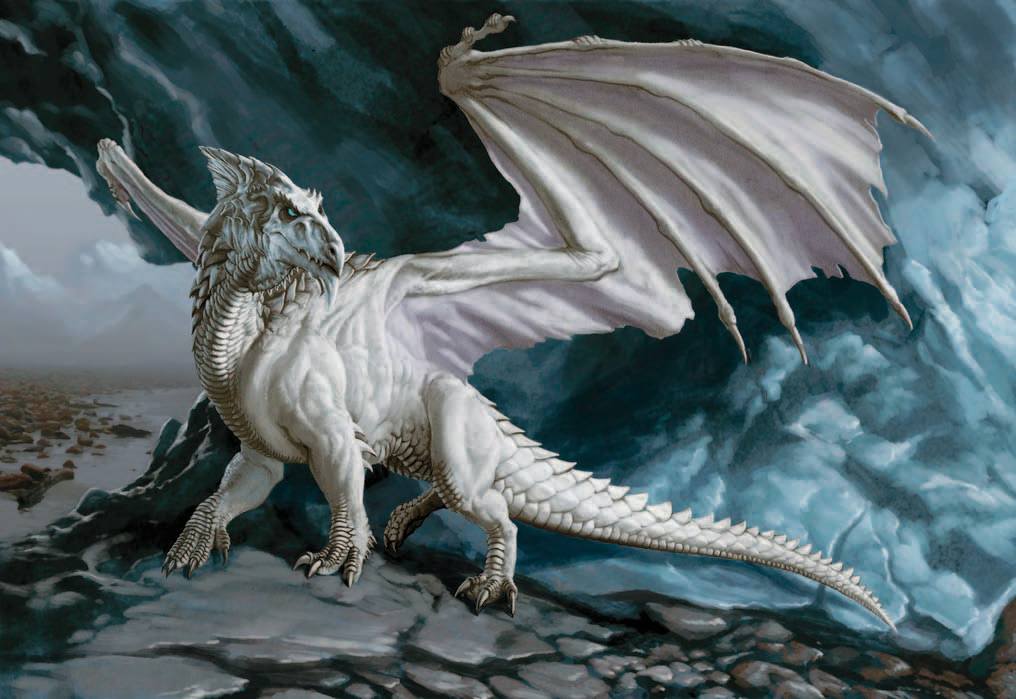
There be dragons in Lost Mine of Phandelver and Dragon of Icespire Peak – and they’re often accompanied by grumbling Dungeon Masters, fretting over how encounters with Venomfang and Cryovain are unbalanced.
There’s actually some really good advice on encounters with dragons in The Rise of Tiamat, which came out four months after Lost Mine of Phandelver. Both adventures were published in 2014, and likely shared drive space at Wizards of the Coast sometime before publication. It’s a shame this advice made it into one adventure, but not the other. It’s pretty straightforward.
“Dragons are among the oldest, most intelligent, and most powerful monsters in Faerûn and the Dungeons & Dragons game. Chromatic dragons are evil and merciless, and every battle against these creatures should be a life-or-death struggle. No dragon should ever fall without the heroes suffering during the battle. Chromatic dragons use every possible advantage with no regard for fairness, and their chief advantage is flight. A dragon never fights on foot where enemies might hack at it when it can soar majestically out of reach and slaughter foes with its breath weapon. Only in its lair will a dragon typically engage in melee, and then only if its hoard is threatened.”
And then this:
“With lifetimes of a thousand years or more to lose, chromatic dragons have no interest in dying in battle against mere humanoids, and they don’t sacrifice themselves nobly for any cause…”
To wit: avoid an anti-climactic encounter with the premier monster in the game by taking great pains to assure that Venomfang and Cryovain are very hard to reach, and are not surprised.
Gifted by nature with the ability of flight, it would seem the first instinct of a dragon should always be to get into the air, and then decide what options are available to them in any encounter – or whether a fight is worth it at all.
Well, at least whether a straight-up fight is worth the bother. Dragons are predators. They like to hunt. They have darkvision and blindsight. They fly. And humanoids need to sleep from time to time. Usually on the ground.
Yes, a young dragon has a multiattack with bite and claw attacks. But to lead with those attacks is a bit like charging into a battle with a bayonette while holding a loaded rifle in your hands.
With a fly speed of 80 ft. per round, a young dragon and can move up to 160 ft. per round with a Dash action – able to move outside the effective range of any ranged weapon or offensive spell low-level characters are likely to have access to.
If the party is significantly weakened after the dragon swoops down for the first use of its breath weapon, perhaps that’s when the beast assesses whether it’s time to get down to the bloody business of bite and claw attacks.
However, if the party still looks dangerous? Perhaps the dragon lazily wheels around in the sky, far out of harm’s reach, awaiting that 5-6 recharge to kick in before having another go with its breath weapon, all while taunting the characters like a boss.
Taunting is probably more in Venomfang’s personality, while Cryovain might be more likely to circle prey like a great white shark, waiting for the best moment to have another go when there’s more blood in the water.
Venomfang may not even be interested in a fight to begin with. But, if he absolutely must fight, I’d like to think he’d be more creative with his tactics than the stat block provides. As the smartest of the chromatic dragons, a green would bore easily if confined to attacks with claws, tail, and breath. He’d want things to be interesting, or at a minimum, amusing.
Academically testing the limits of humanoid squishiness by dropping them from varying heights onto various surfaces sounds like a fun and informative experiment for a green.
Plucking targets with the heaviest armor from the ground to fling him into a nearby pond for some LOLs?
Those tactics sound like a green to me – if they’re going to chance a combat encounter in the first place. They’re smart enough to choose battle they’re most-likely to win. And why kill every humanoid you come across when plots and schemes often require living, breathing humanoids to achieve?
Dragons should be hard to kill, and dare I say, nigh impossible to kill on the first encounter. In fact, I think a DM’s aim should be to make a young dragon more than a combat encounter. Rather, a DM’s goal should be to make them a recurring villain for a more memorable experience.
I’ve been having fun sharing my random D&D thoughts over at Bluesky. If you’re interested in following, I’m at @ticklecorn.bsky.social. I’ll follow back.
If you’d like to support my work, please consider checking out my supplements for Lost Mine of Phandelver and Dragon of Icespire Peak over on Dungeon Master’s Guild! All of my titles are Free/PWYW offerings.


Leave a Reply